A story that stands the test of time.
From warehouse storage to heritage story.
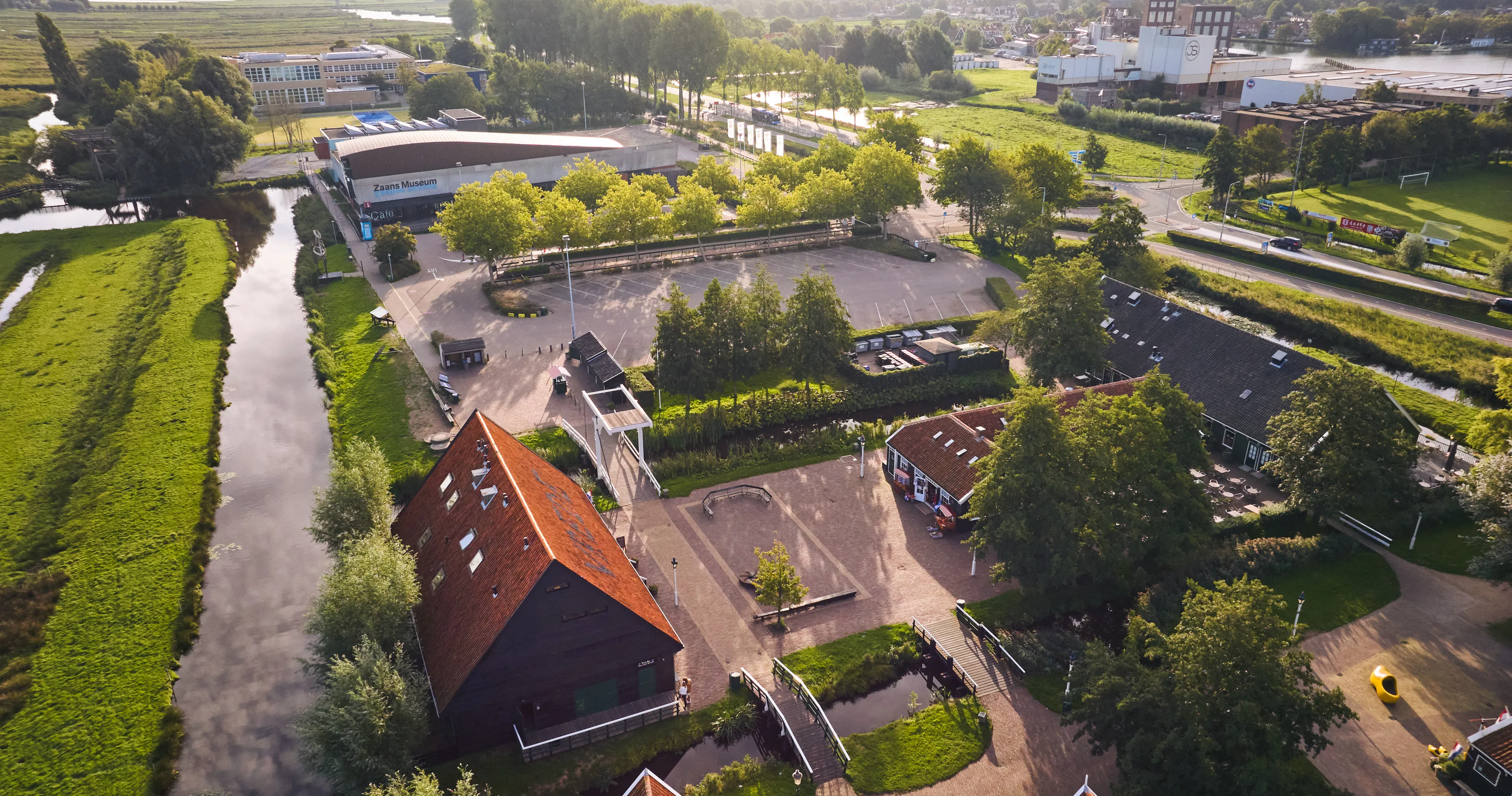
The name of this lane comes from the building Het Kraaienest (Dutch for ‘crows’ nest’), a mill warehouse that served various purposes over the years. When it lost its original function, it was in danger of disappearing, but thanks to careful conservation it is given a new home at Zaanse Schans. Once again it forms part of a historic working landscape.
The story of the warehouse shows that it is not only houses and windmills that are worth preserving, but also the buildings that supported Zaan industry on a daily basis.
Kraaienest 1–3, De Bezem
Built: 1682
Moved to Zaanse Schans: 1976
Local monument (Gemeentelijk monument)
De Bezem was a barn built in 1682 for an oil mill known as De Bezemmaker on Noorddijk in nearby Wormerveer. The barn featured an afluiving: a roofed extension running the full length of the building’s side. The mill itself was demolished in 1896, but the barn remained standing before getting a new purpose with a bakery on the site of the former mill. In the early 20th century, more changes took place: the afluiving was replaced, the shutters were replaced by windows, and the bakery was converted into a café.
As with De Kraai, the owner was Wessanen’s Koninklijke Fabrieken, who wished to sell De Bezem. Upon surveying it, the structure proved to be in such a poor state that only about eight trusses were suitable for reuse. Its usable parts were brought to Zaanse Schans, while the rest was burnt. This demonstrates that heritage conservation does not always mean that an entire building can be preserved – sometimes value lies precisely in the parts that can be saved, as long as there is careful documentation of the whole process.
At Zaanse Schans, the barn is given a new life as a souvenir shop, with a public toilet block for visitors. The former café is converted into a photography print shop with a small office behind it. The print shop is used by the owner of De Saense Lelie, while the small office has been used by the Zaanse Schans foundation since 1976.
Kraaienest 4, Wooden Shoe Workshop warehouse
Built: Mid-18th century
Moved to Zaanse Schans: 1983
Local monument (Gemeentelijk monument)
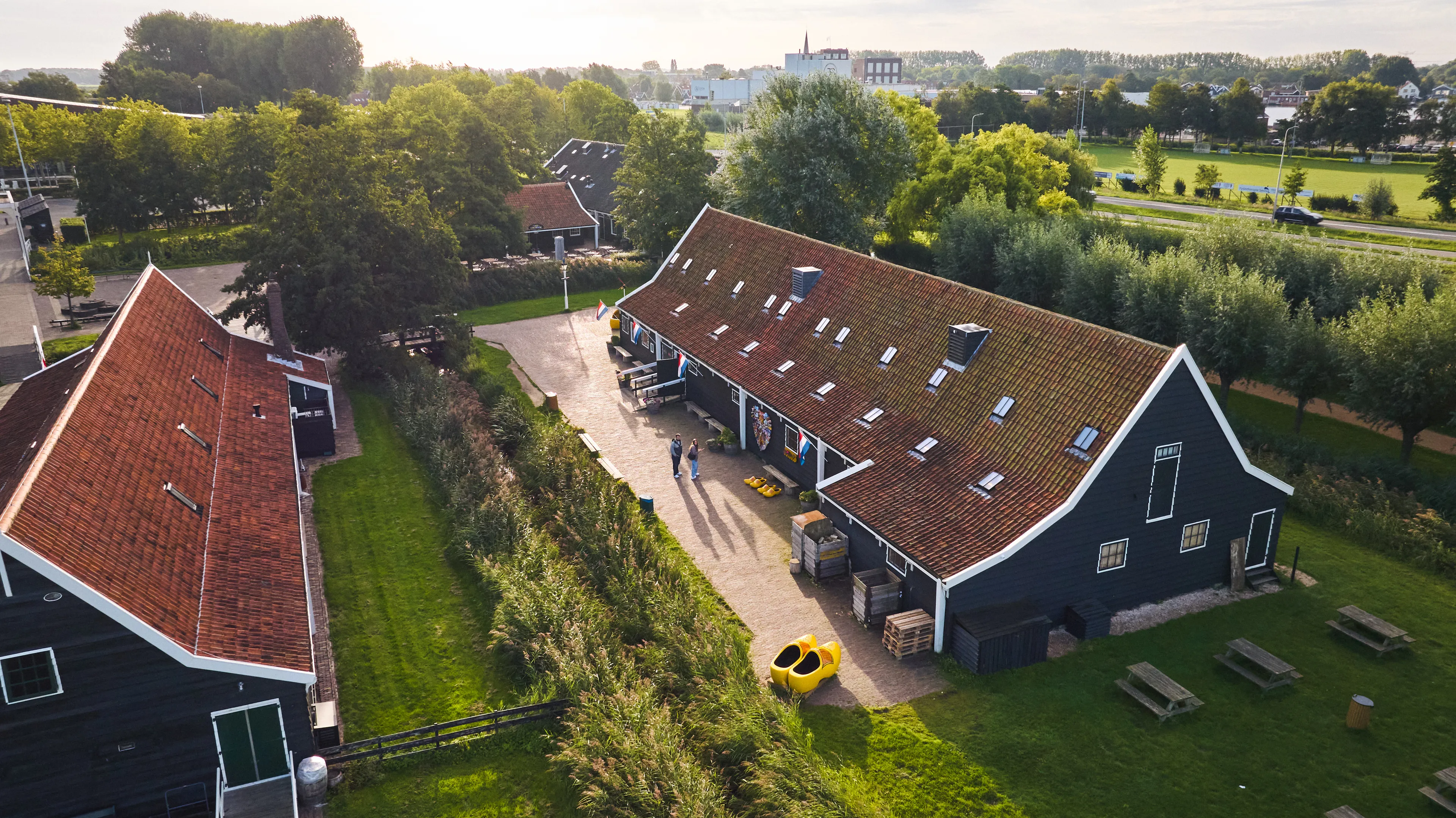
Simon de Jager was not only a councillor but also a mayor of nearby Westzaan. He had this barn built in the mid-18th century on Watermolenstraat in Westzaan, right next to what is now De Saense Lelie. It is a three-part building, with a central aisle crowned by a steep-pitched roof and, on either side, enclosed wings with gently sloping roofs. When it had to make way for a new development in 1976, the owner J Kuyt Jr decided to have it carefully dismantled and the usable parts stored in the hope of giving it a second life.
Thanks to the Zaans Schoon foundation, the building components are gifted to Zaanse Schans – but an ideal location is not immediately available. The barn is eventually placed just south of De Saense Lelie, which is perhaps not the perfect spot from an urban planning perspective – but preserving the warehouse takes precedence. As the foundation is unable to finance the reconstruction itself, the Kooijman clog-makers – already active in the clog workshop on De Kwakels at the time – provide a solution. Commissioned by the Kooijman firm, architect Jaap Schipper draws up a restoration plan, and in 1984 the clog workshop opens at its new address: Kraaienest 4. As the business and its museum continue to grow, the warehouse is extended by 10.8 metres in 1999, with six new bays built in the original architectural style.